
10 Essential System Design Tradeoffs You Cannot Afford to Ignore
The best architects don't stick rigidly to one side of these tradeoffs. They understand that a complex application will use a hybrid approach: strong consistency for inventory, eventual consistency for comments, SQL for core accounts, and NoSQL for the activity feed.
By internalizing these 10 fundamental tensions, you move from merely building software to designing truly resilient, high-performing systems.
Need help mapping these critical tradeoffs to your specific business requirements? Our expert architects can guide your next-generation platform design. Contact us to schedule a system design consultation.
24
Apr


System design isn't about finding a single "best" answer; it's about making a series of informed compromises. Every architectural decision is a tradeoff, forcing you to sacrifice one benefit (like speed) to gain another (like reliability).
For technical leaders, architects, and senior engineers, understanding the tension in these decisions is crucial for building systems that scale, perform, and meet business requirements.
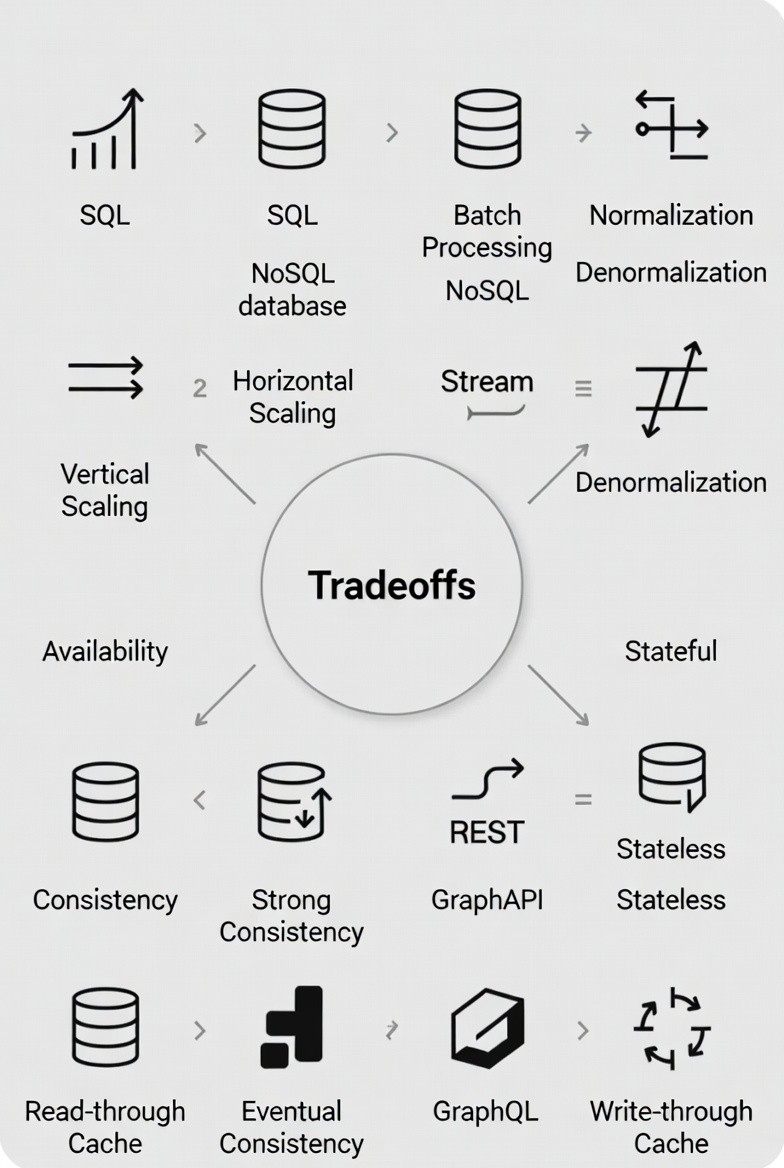
Here are 10 fundamental system design tradeoffs you must master:
1. Vertical vs. Horizontal Scaling
Concept | Description | Tradeoff |
Vertical Scaling (Scaling Up) | Adding more resources (CPU, RAM) to an existing server. | Pros: Simpler architecture, lower latency for single requests. Cons: Single point of failure, finite scaling limit. |
Horizontal Scaling (Scaling Out) | Adding more servers (nodes) to the resource pool. | Pros: Near-infinite scale, high availability (fault tolerance). Cons: Increased architectural complexity (load balancers, service discovery). |
The Choice: Choose Vertical for simpler, smaller applications with predictable loads. Choose Horizontal for web-scale applications demanding high availability and elasticity.
2. SQL vs. NoSQL (Relational vs. Non-Relational)
Concept | Description | Tradeoff |
SQL (Relational) | Data organized into structured tables with fixed rows and columns. | Pros: Strong data integrity (ACID), complex JOINs possible. Cons: Rigid schema, challenging to scale horizontally across regions. |
NoSQL (Non-Relational) | Ideal for flexible schema, key-value stores, or document models. | Pros: Highly scalable horizontally, schema flexibility. Cons: Weaker consistency models, harder to enforce complex relationships. |
The Choice: Use SQL when data integrity and complex, transactional relationships are paramount (e.g., banking). Use NoSQL when high throughput, rapid iteration, and huge volumes of data are the priority (e.g., user profiles, content feeds).
3. Batch vs. Stream Processing
Concept | Description | Tradeoff |
Batch Processing | Collecting data and processing it all at once (e.g., nightly reports, daily billing). | Pros: High efficiency for large volumes, lower compute costs per unit. Cons: High latency, results are always delayed. |
Stream Processing | Processing data in real-time as it arrives (e.g., fraud detection, stock market tickers). | Pros: Near real-time insights, immediate feedback loops. Cons: Higher complexity, requires specialized real-time infrastructure. |
4. Normalization vs. Denormalization (Data Storage)
Concept | Description | Tradeoff |
Consistency | The assurance that every client gets the most recent, identical data after an update. | Pros: High data accuracy. Cons: Requires locking or network consensus, which can reduce availability during partitions. |
Availability | Ensuring the system is always up and running and responding to requests, even if some parts have failed. | Pros: High uptime and reliability. Cons: May return slightly stale data during a network partition. |
The Choice: In a distributed system, you must choose between C and A during a network Partition (P). For financial transactions, choose Consistency. For social media feeds, choose Availability.
5. Consistency vs. Availability (The CAP Theorem)
Concept | Description | Tradeoff |
Consistency | The assurance that every client gets the most recent, identical data after an update. | Pros: High data accuracy. Cons: Requires locking or network consensus, which can reduce availability during partitions. |
Availability | Ensuring the system is always up and running and responding to requests, even if some parts have failed. | Pros: High uptime and reliability. Cons: May return slightly stale data during a network partition. |
The Choice: In a distributed system, you must choose between C and A during a network Partition (P). For financial transactions, choose Consistency. For social media feeds, choose Availability.
6. Strong vs. Eventual Consistency
Concept | Description | Tradeoff |
Strong Consistency | Data updates are immediately reflected across all nodes before the write is confirmed. | Pros: High client confidence in data accuracy. Cons: Slower write performance due to required synchronization. |
Eventual Consistency | Data updates are delayed before being available across all nodes. | Pros: Faster writes, excellent horizontal scaling. Cons: Clients might temporarily read stale data. |
7. REST vs. GraphQL (API Design)
Concept | Description | Tradeoff |
REST | Gathers data by accessing multiple, predefined endpoints ( | Pros: Simplicity, caching is straightforward, clear separation of concerns. Cons: Over-fetching (getting more data than you need), high number of requests. |
GraphQL | Allows clients to specify exactly the data fields they need in a single query. | Pros: Efficient data fetching (no over-fetching), single round trip. Cons: Higher design cost, complex caching, potential for complex backend queries. |
8. Stateful vs. Stateless
Concept | Description | Tradeoff |
Stateful | The system remembers past interactions or data from previous requests (e.g., session management on a single server). | Pros: Simpler local application logic. Cons: Difficult to scale horizontally, high fault tolerance risk (losing state if the server fails). |
Stateless | The system does not keep track of past interactions; all needed data is passed with every request. | Pros: Easy to scale horizontally and load balance, high fault tolerance. Cons: Higher overhead per request (must include credentials/session info every time). |
9. Read-Through vs. Write-Through Cache
Concept | Description | Tradeoff |
Read-Through Cache | On a cache miss, the cache itself loads the data from the database and returns it. | Pros: Simplified application logic. Cons: Higher latency on the first access (cache miss) as the cache must fetch the data. |
Write-Through Cache | Data updates are simultaneously written to the cache and the primary storage. | Pros: Consistency between cache and database on writes. Cons: Increased write latency (must wait for two successful writes). |
10. Sync vs. Async Processing
Concept | Description | Tradeoff |
Synchronous Processing | Tasks are performed one after another; the system waits for the task to complete before moving on. | Pros: Simple, deterministic, easy to debug. Cons: High blocking time, poor resource utilization, slow response for long tasks. |
Asynchronous Processing | Tasks run in the background (via queues/workers); the system returns immediately and continues with new tasks. | Pros: High concurrency, immediate response, excellent resource utilization. Cons: Increased complexity (queues, workers, handling failures), harder to track task state. |